
Unified Enrollment Platform for a Charter School Management Company
Executive Summary
- One of the largest charter school management companies, operating across multiple states in United States faced growing complexity in managing student enrollment for their clients. The organization supported 5 education brands, 38 charters, and more than 130 learning centers, each with its own enrollment process, staff, and operational requirements.
- Their previous approach created operational inefficiencies, limited visibility into enrollment performance, and made it difficult to deliver a consistent experience for prospective students and families. Leadership lacked reliable, network-wide enrollment data, while local teams relied heavily on manual processes to manage inquiries, registrations, communications and approval workflows.
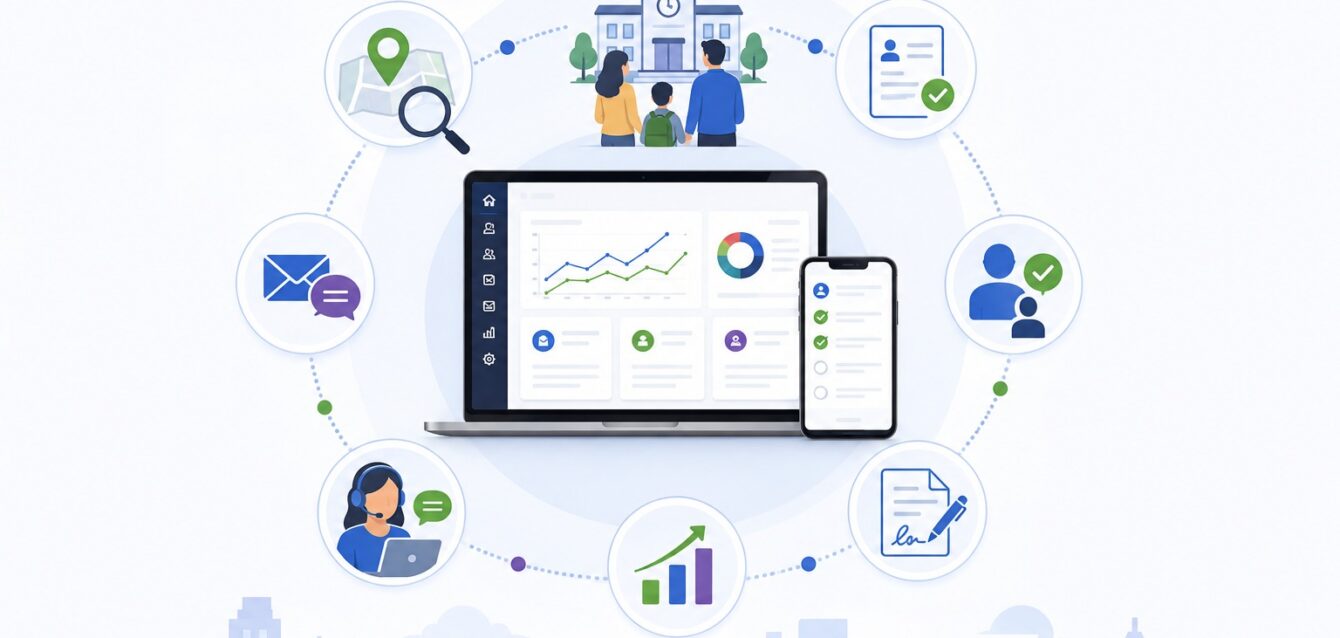
- To address these challenges, we designed and implemented a centralized enrollment platform that supports all brands, charters, and learning centers through a single application. The platform introduced standardized enrollment workflows that were configurable for each brand, centralized administration, automated communications, inquiry tracking, and digital approval processes while preserving the unique identity and operational requirements of each brand and charter.
- The solution transformed enrollment from a collection of disconnected local processes into a scalable, data-driven operation. Since implementation, the platform has processed 10,000+ primary enrollments and 12,000+ secondary enrollments. The organization experienced approximately 32 percent enrollment growth following launch and has achieved year-over-year enrollment growth of 12 percent for 2026, while significantly improving operational visibility and administrative efficiency.
The Challenge
The organization supports of the largest networks of public charter schools in the United States. Its structure includes:
- 5 brands
- 38 charters
- More than 130 learning centers across multiple states
Before the platform was introduced, enrollment activities were managed independently across locations. This created several operational challenges:
- Student information was stored in multiple systems with limited visibility across the network.
- Enrollment processes varied by location and often relied on manual workflows.
- Leadership lacked a centralized view of enrollment performance.
- Prospective students and parents experienced inconsistent registration processes.
- Communication and follow-up activities were difficult to track and standardize.
- Prospective students and parents who expressed interest were not systematically tracked. Once an inquiry was submitted, there was limited visibility into follow-up activities, making it difficult to understand whether that interest resulted in an enrollment or was lost during the process.
- Secondary enrollment approvals relied on manual signatures from supervisors and teachers. Documents often had to be printed, physically routed for approval, and manually signed, creating delays, increasing administrative effort, and making it difficult to track approval status.
The Solution: A Unified Enrollment Platform for Scalable Growth
We developed a unified enrollment platform designed to support the entire network through a single application and shared data model. The solution was built around three objectives:
- Create a consistent enrollment experience for students and families.
- Provide operational visibility across all brands and locations.
- Support growth without increasing administrative complexity.
The platform includes:
Learning Center Discovery
Prospective students and parents can search for nearby learning centers using geographic information and quickly identify the most relevant options based on location and program requirements.
End-to-End Digital Enrollment
The system supports the complete enrollment process, from initial interest submission through full student registration.
Dynamic Multi-Brand Experience
Content, branding, contact information, and enrollment rules are configured based on the selected learning center, allowing multiple brands to operate on the same platform without sacrificing identity.
Centralized Administration
Staff can manage enrollment activity through a single dashboard, including:
- Record review and processing
- Status tracking
- Reporting and exports
- User access management
- Communication history
Automated Engagement and Notifications
Email notifications are automatically triggered at key stages of the enrollment process, improving consistency and reducing manual effort.
Student Interest Management
The platform captures and tracks every student inquiry from the moment a prospective student or parent expresses interest. Enrollment staff can monitor follow-up activities, update engagement status, and guide prospects through the enrollment journey. This creates a clear path from initial interest to completed enrollment while providing visibility into conversion performance across all locations.
Digital Approval and Governance
The platform digitized the secondary enrollment approval process by introducing electronic assignment and signature workflows. Enrollment records can be routed to the appropriate supervisor or teacher for review, approval, and digital signature directly within the system. This eliminates paper-based processes, reduces approval turnaround times, provides auditability, and enables staff to track approval status in real time.
- Reduced paperwork and manual administrative tasks through digital approval and signature workflows.
- Faster processing of secondary enrollment applications and approvals.
- Improved visibility and auditability of enrollment approvals across locations.
Business Impact
The platform delivered measurable operational and business outcomes across the organization.
Learning Centers Supported
Secondary Enrollments
Primary Enrollments
Year-over-Year Enrollment Growth (FY 26)
Enrollment Growth After Launch
Beyond the measurable results, the organization realized significant strategic benefits, including improved conversion visibility, streamlined operations, faster approval cycles, stronger reporting capabilities, and reduced administrative effort.
Improved Conversion Visibility
For the first time, enrollment teams could track prospective students from initial inquiry through completed enrollment. This provided clear visibility into conversion performance, enabled more effective follow-up activities, and reduced the number of interested families lost during the enrollment journey.
Streamlined Operations
Standardized workflows replaced fragmented location-specific processes, creating a more consistent experience for families while reducing operational complexity for staff.
Faster Approval Cycles
Digital routing, review, and signature capabilities eliminated paper-based approval processes. Supervisors and teachers could review and approve enrollment requests electronically, reducing processing delays and improving accountability.
Stronger Data and Reporting
A centralized data model provided leadership with a single source of truth for enrollment activity across all brands, charters, and learning centers. This enabled more reliable reporting, performance monitoring and decision-making.
Reduced Administrative Burden
Automation of communications, status tracking and approval workflows allowed enrollment teams to focus more time on supporting students and families rather than managing manual administrative tasks.
Key Takeaways
Standardization Enables Growth
As organizations expand across multiple locations, locally managed processes often become difficult to sustain. Establishing common enrollment workflows and shared operational standards created a foundation that could support continued growth without increasing complexity.
Digital Workflows Reduce Operational Friction
Replacing paper-based approvals and manual communications with automated digital processes shortened enrollment timelines, improved accountability, and enhanced the experience for both staff and students and parents.
Enrollment Extends Beyond Registration
The project demonstrated that successful enrollment management begins well before formal registration. By tracking and nurturing prospective student interest, the organization was able to better understand demand, improve engagement, and increase conversion opportunities.
Configurable Platforms Create Long-Term Flexibility
A shared technology platform does not mandate operational uniformity. Through configuration-driven design, the organization was able to support diverse brands, charters, and enrollment models within a single scalable system.
Conclusion
The transformation initiative enabled the organization to move from a collection of local processes to a consolidated enterprise-wide enrollment operation.
- By centralizing enrollment management, inquiry tracking, communications, reporting and approval workflows, the organization established a scalable foundation capable of supporting continued expansion across brands, charters, and learning centers.
- The platform not only improved operational efficiency but also strengthened the organization’s ability to engage prospective students and parents, monitor performance, and make data-driven decisions. As enrollment volumes continue to grow, the solution provides the flexibility and visibility required to support future expansion while maintaining a consistent experience for students, parents, and staff.
- Today, the platform serves as a critical operational system supporting thousands of enrollment journeys annually and enabling the organization to scale with confidence.
I recommend without hesitation Bangalore Softsell as a reliable and dependable partner for software project outsourcing needs. They diligently worked on our unified enrollment platform project for charter schools in all aspects such as requirements analysis, software design, coding, testing and QA. They delivered on time, within budget and supported us not only in the product rollout for our customer but continued support thereafter. They have earned our trust and we will continue to engage them in our future projects as well.